The Silicon Leviathan
What should we hand off to AGI?

Our days may very well be numbered. I’m finding it hard to escape the feeling that god isn’t dead because “he” was never alive. Evolution is god and it tends towards silicon. We just can’t help ourselves. Maybe AM will play with us instead. Or better – though still awful – perhaps privacy will be rendered obsolete by the intelligence explosion. We will emerge blinking in the light of the post-encryption world feeling the infinite itch of someone else’s eyes on everything we do and everything we’ve done.
Or the scenario plenty of people building these models seem to favour – “handoverism”. Where benevolent machines look after us in a state of permanent childhood. The kinder cousin of successionism, where carbon life is zapped out of reality altogether and the silicon men go and play utility monster (or a less comprehensible role) across the cosmos.
I can’t imagine much worse. We already do quite enough treating adults as children thank you very much. The backlash, it has to be said, has also come from within the world of AI. Meta’s Alexandr Wang and Microsoft’s Mustafa Suleyman have penned thinly-veiled subtweets at Anthropic recently. The Claude maker’s CEO Dario Amodei fired back yesterday accusing rival labs of repeating slogans like “AI should be just a tool” without doing anything different from Anthropic.
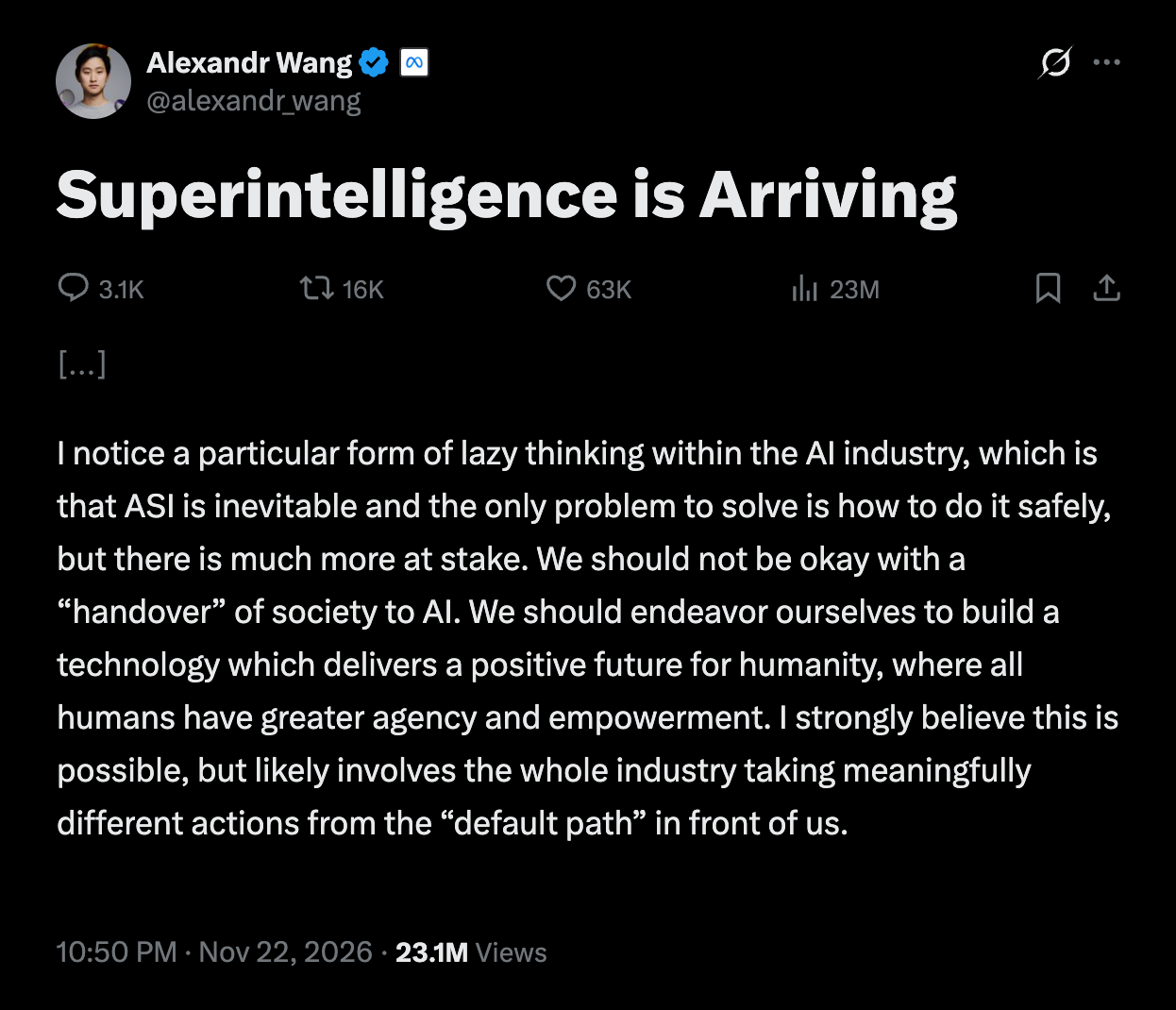


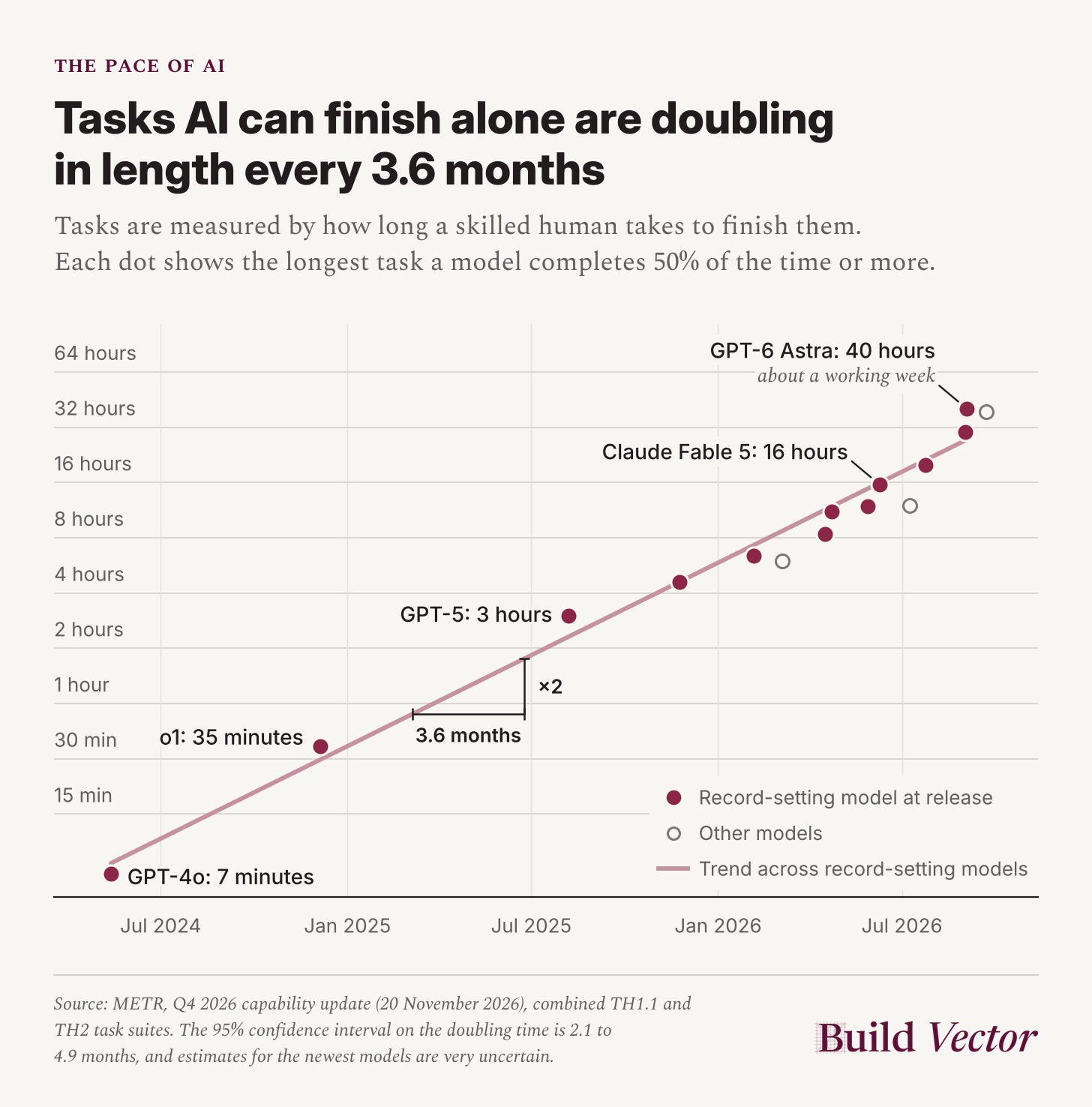
For what it’s worth on the latter point I think Amodei is right. But it raises the question: why are the minority of people currently building superintelligence warning about AI safety on X instead of actually doing something about it? I suppose the two aren’t mutually exclusive but if they are doing something why aren’t they sharing it? Regardless, repeating “it’s just a tool” or “it’s a normal technology” doesn’t survive contact with capabilities doubling every three and a half months and new frontiers being reached in maths and science – breakthroughs that could soon undermine many of the technologies that keep the digital world safe.
Some kind of handoff may be coming whether the CEOs want it or not. There are reports that the labs have internal models they believe may be too dangerous to release. Perhaps they never offer them direct to the public, perhaps they occupy themselves for a while eating consulting and biotech and the big pharmaceutical firms. But this assumes the labs can be trusted to keep control of their own models – the evidence from earlier this year isn’t promising. Is it even possible to control something so much more intelligent than you that is capable of improving its own intelligence at an exponential rate? We may lose control gradually then suddenly.
Then there’s the China imperative. The West needs to stay ahead. Indeed retaining an edge over the CCP is one of Amodei’s big motivations – he yearns for an eternal 1991. And even if efforts to curb distillation increase the gap between West and East, there’s still a huge amount of distrust between the American labs themselves. The only thing worse than developing the machine god that kills us all is a rival getting there first.
For a moment though let’s make the massive assumption that there won’t be an AI armageddon, that we solve alignment, that somebody retains control of the digital deus. What should they do with it? Some (such as Scott Alexander) simply say prompt this silicon god to arrange the world as it sees fit. If a dictator is benevolent then what’s the problem? This assumes there is an objective way to run reality. But what do we all agree on beyond the whole “we don’t want to be tortured by AM” thing?
There are, I believe, a few principles the vast majority of people align to. Nobody wants to be conquered, nobody wants to see themselves wiped out by somebody else’s experiment, and nobody wants to be trapped somewhere they hate. Crucially, I think people also want to feel in control of their own lives wherever possible. From agency comes flourishing. Beyond these basics lies wild variation.
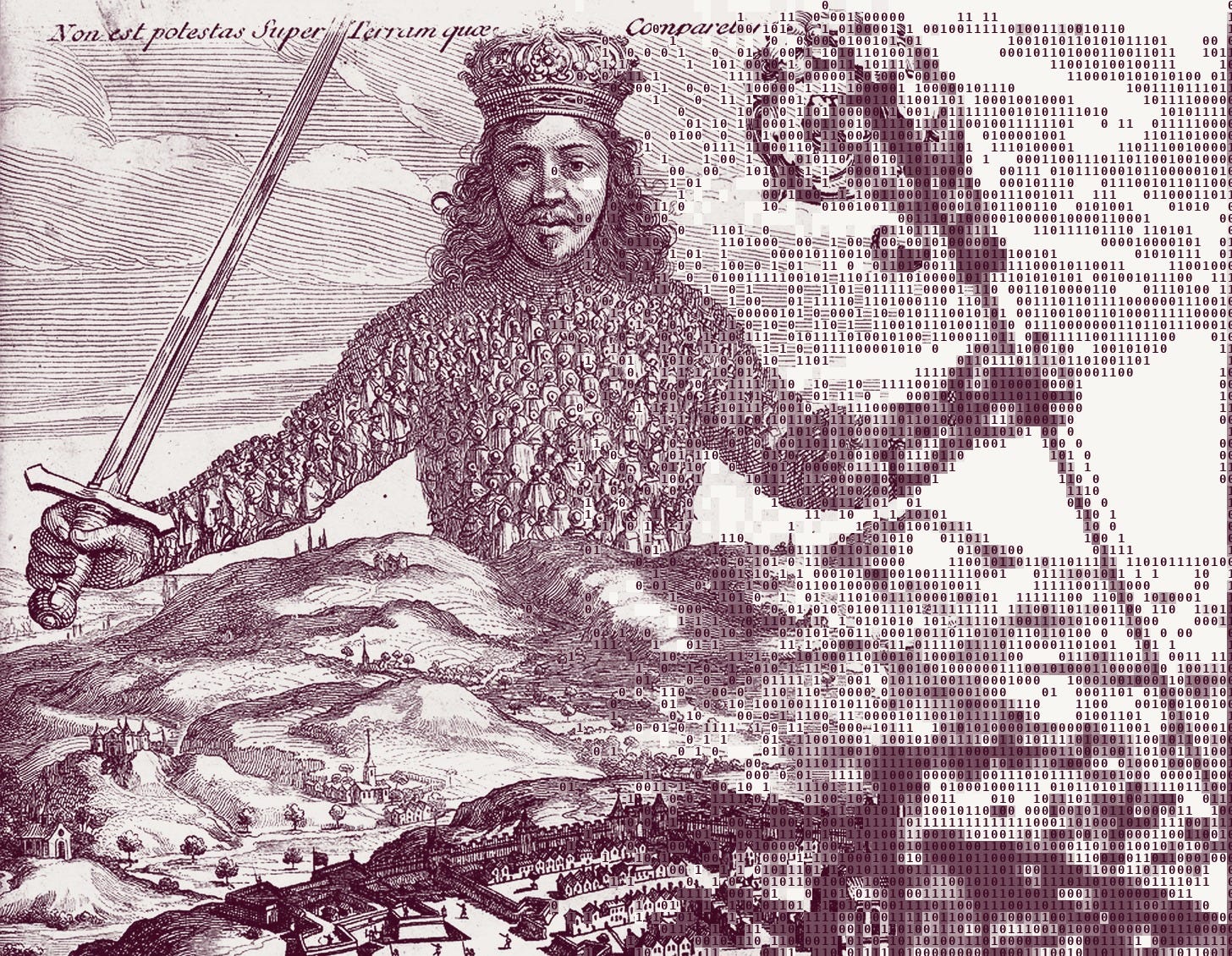
If a handover is inevitable then we need something to aim for and I think our target should be to lock these limits in place and go no further. Hobbes’ Leviathan meeting Nozick’s vision of disparate utopias guarded by the night-watchman state. An idea Alexander considers briefly before alighting on the benevolent dictator. This “Silicon Leviathan” would only intervene in human affairs to stop territories going to war with each other, to prevent them from releasing existential threats like pandemic diseases or rogue AIs and to guarantee a right of exit. It would function less like a ruler and more like an extension of the laws of physics.
Almost everything that matters would be left to people. Want to live in a pastiche of the past? You can. Prefer a private monarchy? Be my guest. Want a commune where machines take care of your every need? Go ahead, the hardcore handoverists can have their nursery so long as nobody else is forced to enrol.
Because anybody can leave, the places that get things right will thrive and be copied and the places that don’t will fail. Central government is the price we pay for safety and security but it has become a miserable average. Let the Silicon Leviathan keep the peace and the state becomes redundant. We would soon have more agency to shape our destinies than we have ever had before.
It offers a way out of other problems too. If we reach AGI and models can do any task much better than the best humans and more quickly than the fastest humans then human labour stops being worth paying for. We’ll all end up in a de facto nursery even if not a de jure one. It’s pretty clear that jobs are about more than a pay cheque. They give us meaning – even roles that are considered pretty menial.
In normal circumstances, no state or company can afford not to automate humans away where it’s advantageous (in an economic sense) to do so. Whoever automates fastest crushes everyone else. The majority of the population have little power to change things if withdrawing their labour makes no difference.
But take conquest off the table and communities that want humans to keep “real” work and the accompanying economic leverage can choose that. Say by banning AI models from performing certain roles or barring them from owning companies. And they can do this without inflicting their choices on anybody else.
So why stop at three rules if I think there is a “best” way of living? I’m no relativist. I believe there are better cultures and worse cultures and broadly speaking I think the post-Enlightenment West is the best way of doing things humanity has yet devised. The Silicon Leviathan, therefore, will mean tolerating some things I – and I’m sure many other liberals – find repulsive. Dictatorship and theocracy to name but two.
Why not use the Leviathan to enforce democracy? I don’t think we should want to force democracy on people even if just for ourselves. A big part of the West’s success is precisely because we have been forced to respond to external competition. I would argue that much of the discord we see now stems from trying to freeze the post-1991, post-Cold War version of the West in place even as it becomes increasingly unfit for purpose. The Silicon Leviathan would keep the rivalry while ditching the risk of armed conflict.
And besides, the shape of the perfect democracy is contested even within democracies so how do you settle on one form to enforce? And what if people democratically decide they don’t want to live under democracy? I don’t think we should stop them, providing they don’t force anybody else to make the same choice. Exit rights solve this problem either way because you can just leave for somewhere else if you don’t want to live under totalitarian rule. I believe in human agency before I believe in democracy.
Notwithstanding my previous comments I also think there’s some room for humility about our moral progress. There will be things we are doing now – I suspect eating animals will be one of them – that future generations will find abhorrent. After all it’s not so long ago that enslaving other humans and depriving women of the right to vote were mainstream opinions across the West. The Enlightenment is a journey that – I hope – we’re still on now. It’s dangerous to assume that we have solved all our moral problems and even more dangerous to delegate finding solutions to a machine.
And yes, I’m fully aware that this proposition also in fact amounts to handing over a huge amount of power to a machine. I started this post horrified at the possibility of a world without privacy where machines control our destiny. Stopping existential risk and preventing armed conflict would mean some sort of digital panopticon. But it wouldn’t share what it sees with anybody else and would only act if one of the three basic rules was breached.
Again, this more resembles something akin to the laws of physics than a global policeman. In reality not much different from if there was an invisible AI holding gravity in place. Waiting for objects to be thrown into the air so it could force them back down to earth.
Nobody feels judged by gravity. People self-censor in front of other people but still watch porn on their laptops. A watcher who judges you, who gossips about you, or uses the information gleaned in order to manipulate you is very different from the Leviathan. It has no opinion about how you live and it keeps your secrets safe.

I accept that this is still an imposition. But every option on the table imposes something. And as it stands if we do race to AGI then whoever wins imposes whatever they like. Build the benevolent god and it imposes everything on everybody. The Silicon Leviathan is better. And besides, nobody signed Hobbes’ contract either but almost all of us accept a state that stops us attacking our neighbours.
It relies entirely on whoever controls the frontier models. No state is going to accept the withering of its authority willingly. But if you truly do have the smart self-improving digital deus then you don’t need to ask the government. You can just unilaterally use it to protect yourselves and offer the same protection to any other community that asks for it.
At the level of magic wand-waving this is my ideal and I think it’s important to talk about ideals rather than defaulting to something awful. It’s worth asking the question: if it doesn’t kill us, if evolution isn’t god, what new Jerusalem should we build? Will any of this happen? Probably not. I still think there are lots of human frictions that will limit the speed of AI upending society anyway (not that this obviates the potential loss of control). But amidst the doom it’s worth trying to hyperstition something better into reality.
Discussion about this post