


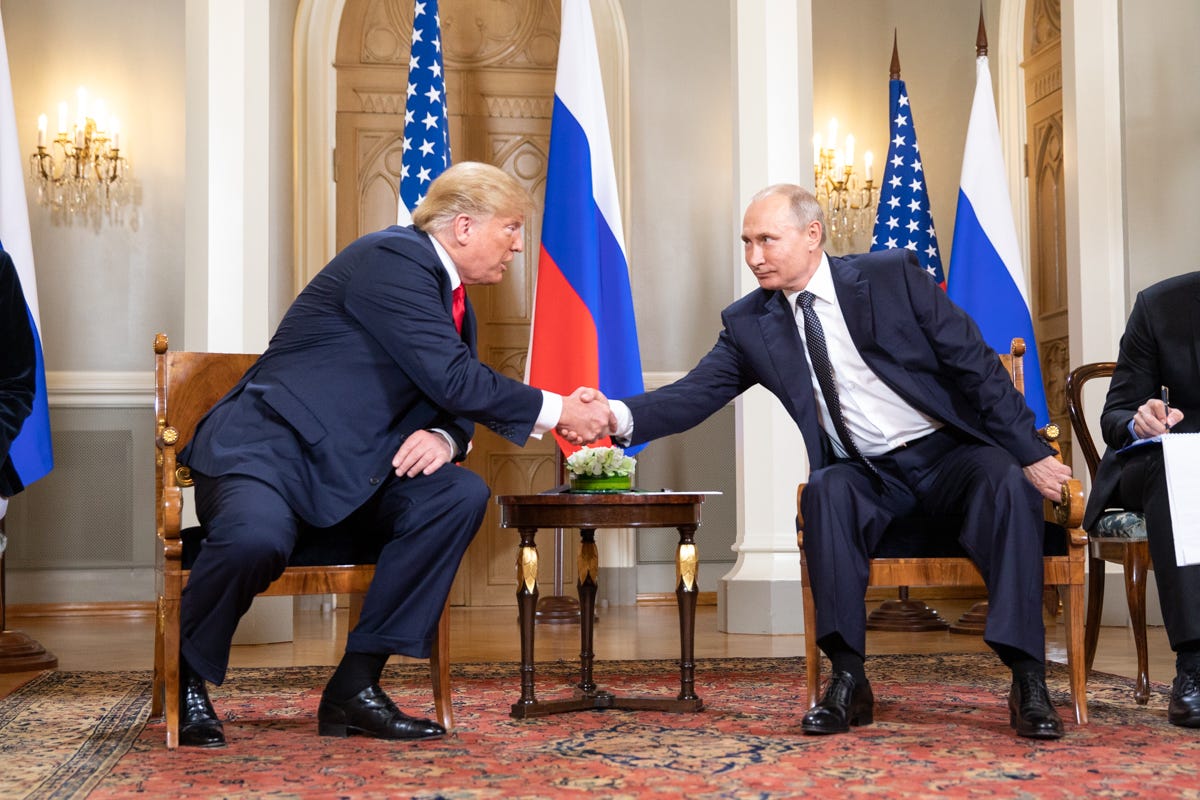
Erstwhile Atlanticist I may be, but the fact the scales have long since fallen from my eyes doesn’t temper my sadness at the state of America. Nor does it make the obvious conclusion after the last year, and in particular the last week, any easier: that Europe (including Britain) must get serious or we are damned.
It should come as no surprise that Trump is threatening Europe over Greenland. The continent, Britain perhaps more than most, spent 2025 acting as if the normal rules of West-on-West diplomacy still applied to America. They do not.
Trump is an evil man who governs in naked self-interest, but far more terrifying than the third-rate mind bullying Europe’s democracies is the fact he is able to do with seemingly no limits.
America’s institutions are supine and its politicians are all – whatever side of the aisle they sit on – cowardly, impotent, or a combination of the two. A robust nation isn’t led by men who are evil or senile; from 2017–2021 the US was led by the former, from 2021–2025 it was led by the latter, and now it appears blessed with both. This is the pattern of a superpower in freefall.
“The American people were prepared to re-elect a man who tried to destroy their democracy; who might they invite into the Oval Office next?”
Trump has the attention span of a gnat; to call him a third-rate mind would be an undue kindness. He may forget about Greenland as quickly as he has turned the island into a crisis; he may move on to the next bout of law-breaking, to cause the next international incident that drives America’s allies into the hands of the Chinese or pushes them onto the warpath of the Russians.
Perhaps we get through the next three years with gentle diplomacy, pretending that Trump is an aberration. But the American people were prepared to re-elect a man who tried to destroy their democracy; who might they invite into the Oval Office next?
As it turns out Trump is not Hitler; he has no grand ideological mission; he believes in “the great replacement” only so far as it serves his ends. Far worse is that the corrupted and enfeebled American polity is ripe for somebody brighter and more principled but no less evil to inflict much greater harm on the world – and the American people.
And then there’s always the chance Trump does follow through on his threats, either today or some other time in the next three years; he is, after all, both stupid and selfish. Either way, this is not a country to be relied upon or that can be gamed into continuing as our security blanket.
Getting Serious
The depth of our defensive reliance on America is staggering. To use Britain as an example: our Trident nuclear deterrent relies on missiles that can only be maintained and repaired by the U.S.; our F-35B fighter jets rely on American data and parts; our air-air refuelling capability is limited; and we lack the munitions or “magazine depth” to keep our guns and artillery firing for more than a few weeks without U.S. industrial capacity. These are just a few examples; there are many more across the continent.
We urgently need to divide our defensive labour. Europe has 178 different types of defence system compared to the 30 used by America. It would be more efficient if the big powers could put aside nationalistic concerns about domestic designs and harmonise around a smaller number of systems. That way, they could benefit from easier repairs and economies of scale.

Similarly, there needs to be a smarter distribution of abilities. Britain and France should take on the burden of replacing the American nuclear umbrella. Maintaining – and realistically improving and expanding – a nuclear deterrent is expensive, so the British and French should focus their resources here, while the other major European powers such as Germany and Poland can focus on conventional forces.
While this would require a radical shift towards a joint Anglo-French nuclear doctrine, the alternatives are more proliferation or continued reliance on America. The former is undesirable; the latter is impossible.
“We have created a continent of conservatives who care more about reducing risk than nurturing talent.”
Just as important as defence is the growth needed to pay for it. Europe is a continent making yesterday’s goods, such as combustion engines, when it needs to be unleashing the technologies of tomorrow. The reason it hasn’t done so, and the reason why there is not a single British or European tech giant, is because we have regulated them out of existence.
We have created a continent of conservatives who care more about reducing risk than nurturing talent. The EU should ditch onerous regulations that chase away investment, like the Digital Markets Act, and should implement the reforms proposed by the Draghi Report in full.
The Labour government in Britain should do what it was elected to do and dash for growth, going full speed ahead on planning reform and ditching the Online Safety Act and its onerous workers’ rights legislation.
Shifting the Vibe
To do all of this, we will need three massive things. Firstly, a culture shift: we need to ditch the precautionary principle that has opened up an innovation chasm between Europe and America. If you become experts in banning and regulating, you simply choke off new ideas before they can bring social and economic goods, and in the end, you run out of things to regulate and ban. The free world needs a new leader, but we don’t currently look like we care enough about the “free” bit.
Secondly, it’s going to require flexibility and the acceptance that Europe may need to create new institutions or formations rather than rejigging its current bloated setup.
If Hungary and Czechia don’t want to be involved, they don’t have to be, but they shouldn’t stop others who do care about democracy from standing up to defend it. We should probably revisit Macron’s “Europe of concentric circles” idea – different institutions with different levels of integration. Apart from anything else, no serious defensive framework for Europe can be created without Britain, and we don’t look to be rejoining the EU any time soon.
Lastly, and perhaps most importantly, our politicians need to grow up and level with their electorates. As long as they keep pretending that diplomacy will win the day and that the America we know and love will return, they will be hard-pressed to justify making difficult choices domestically.
Leaders can’t act as if Trump is merely misguided while re-arming like it’s the 1930s; they need to tell it like it is: America is in the grips of authoritarianism, possibly irreversibly, and they do not care about us anymore.
The evidence from Canada last year and Denmark more recently suggests that voters do rally around the flag when they see a critical threat to national security, so this may not be as unpopular with voters as European politicians fear. Similarly, many of Europe’s reactionary populists – the forces incumbents are currently struggling to keep out – have spent years tethering themselves to the Trump project.
A crusade for strategic independence could help to keep them out and stop what has happened in Washington from happening in London, Paris, and Berlin – though we shall see; the alternative is that it moderates them, as we have seen from Meloni in Italy.
The transatlantic rift really pains me because I loved the American project: the country of Washington and Lincoln and (Theodore) Roosevelt and JFK. It was, until a few years ago, my ambition to move there. Instead, it seems the best alternative is to help make Europe the new land of the free.
Alas, we need to treat America as a lost cause. The country has triumphed over internal strife many times before, but we cannot gamble our future security and prosperity on the chance it will do so again.
Thank you for reading Build Vector, if you’ve enjoyed this piece then please consider subscribing, it’s free and you have nothing to lose except a tiny portion of your life. You can find me on X @Jack_Nostalgic